
Donate here

If you’re willing to donate kidney or want more information, please click the button below. It will direct you to the University of Minnesota’s form for starting the donor workup process. Thank you for choosing to give life.
-Josh
FAQs
Below is a list of frequently asked questions for those considering donating their kidney. If you have any other questions or can donate a kidney, feel free to reach out to me, Josh, at donate@kidneysr.us
What are the risks involved?
Donating a kidney does not have any long-term effect on health. Donors may experience a slight rise in blood pressure and a small amount of excess protein in the urine following surgery. There is no greater risk of developing kidney failure after donating a kidney than anyone in the general population.1
Read More
What are the requirements for being a living kidney donor?
Requirements for kidney donation vary by transplant center. At a minimum, you must be 18 years of age, in good health, with normal kidney function and no major physical or mental illnesses. There are a number of other factors to consider, all of which will be addressed during the evaluation process should you decide to become a living kidney donor.2
What is the recovery time?
The minimum amount of time you should allow yourself to recover is four to six weeks. Because people recover at different rates, with varying degrees of fatigue and pain, you may need as long as eight to 12 weeks leave from work.5
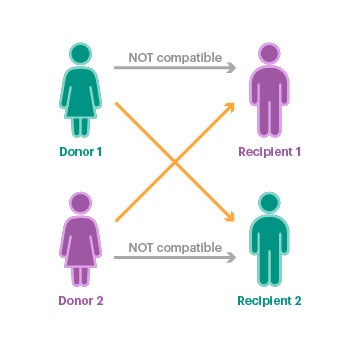
What if I don’t match?
When a person is in need of a kidney (Recipient A) and has a willing donor (Donor A), but that Donor A is either a poor match to Recipient A or not a match at all, the National Kidney Registry can find a recipient who is in need of a kidney (Recipient B) and has a donor (Donor B) who is willing to donate, but is either a poor match or not a match at all to Recipient a, but is a match to Recipient A and have them swap.2
What about insurance?
Generally, the recipient’s Medicare or private health insurance will pay for the following for the donor (if the donation is to a family member or friend). Donors should always coordinate their tests with the transplant coordinator at the hospital in case there are any exceptions3
Does the donor need to be a relative?
Any healthy person can choose to become a kidney donor. The donor does not have to be a relative or even be related to the intended recipient. Through kidney paired exchange, the transplant team ensures that the recipient receives the best transplant for their kidney health. 1
Is a kidney transplant from a living donor better than one from a deceased donor?
Kidney donation from a living donor provides some major benefits including:
- Better match: A donor-recipient match is important during kidney donation. It ensures that the recipient’s body will accept the new kidney.
- Improved long-term transplant kidney survival: Kidneys from a living donor are usually healthier and last longer than deceased donor kidneys
- Faster access to transplantation: Individuals can receive a living donor transplant before starting on dialysis and eliminates the wait time needed for a deceased donation1
What if I live far away?
There are a few options. One is traveling here and you have to stay a week for recovery. The other is “remote donation”. Basically you donate at a location near you, and that will give a ‘voucher’ for me to get one here. Its all coordinated through the National Kidney Registry4
- https://www.pennmedicine.org/for-patients-and-visitors/find-a-program-or-service/transplant-institute/living-donor-kidney-transplant/frequently-asked-questions
- https://www.kidneyregistry.org/for-donors/faq-for-donors/
- https://www.kidney.org/transplantation/livingdonors/financial-insurance-issues
- https://www.kidneyregistry.org/for-centers/remote-donation/
- https://www.ucsfhealth.org/education/faq-living-kidney-donor#:~:text=The%20minimum%20amount%20of%20time,recover%2C%20should%20you%20need%20it.
 KidneysRUs